
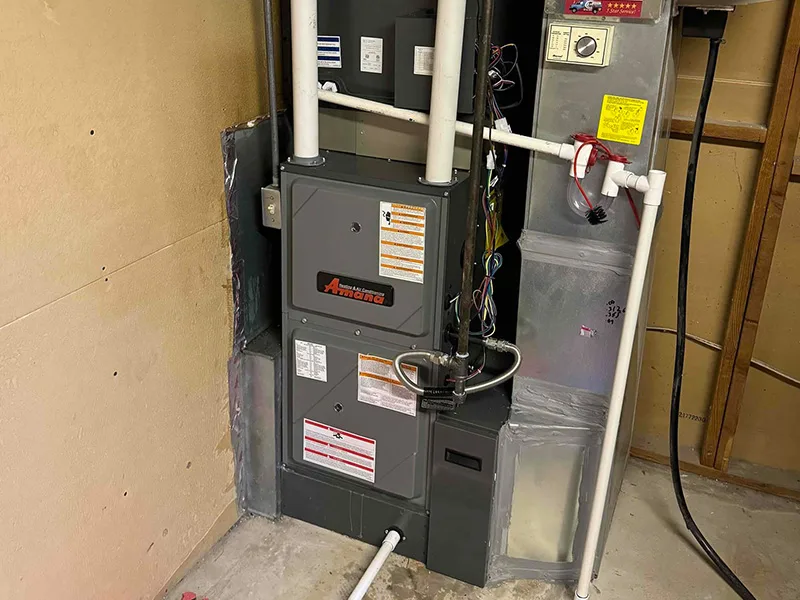
New furnace cost for most US homeowners runs between $4,000 and $8,000 installed. Budget gas models start near $2,500, and high-efficiency systems with new ductwork can top $12,000. So what separates a $3,000 quote from a $10,000 one?
Table of Contents
Seven factors set your price. This guide breaks down each one, shows typical costs, and tells you how to save without buying a furnace that fails early.
Quick Answer: New Furnace Cost by Fuel Type
| Fuel Type | Typical Installed Cost | Best For |
| Natural gas | $3,500 to $8,000 | Homes with a gas line and cold winters |
| Electric | $2,000 to $7,000 | Mild climates or homes with no gas service |
| Propane | $3,500 to $8,000 | Rural homes without natural gas |
| Oil | $4,500 to $10,000 | Older homes in the Northeast |
These prices include the furnace and standard labor. Ductwork, permits, and upgrades come on top.
1. Fuel Type
Fuel type sets the baseline for your new furnace cost. Gas furnaces cost more to buy than electric ones, but gas usually costs less to run in cold climates. Electric furnaces cost less up front and install easily, but electricity often costs more per unit of heat.
Switching fuel types adds money. If you move from oil to gas, for example, a crew must run a new gas line and install new venting. Those jobs can add $500 to $3,000.
Tip: Ask your contractor to compare the 10-year cost of each fuel, not just the purchase price.
2. Efficiency Rating (AFUE)
AFUE tells you how much of your fuel becomes heat. A 96% AFUE furnace turns 96 cents of every fuel dollar into warmth. An 80% unit turns only 80 cents.
| Efficiency Level | AFUE | Typical Installed Cost |
| Standard | 80% | $2,500 to $5,500 |
| High efficiency | 90% to 98% | $4,000 to $8,500 |
High-efficiency furnaces cost more because they use a second heat exchanger and need special PVC venting. In cold regions, the fuel savings often repay that extra cost in several years. In mild climates, the savings take much longer.
3. Furnace Size (BTU Output)
A bigger furnace costs more, but a bigger furnace is not a better furnace. An oversized unit turns on and off too often. It wastes fuel, wears out faster, and leaves some rooms uneven.
An undersized unit runs nonstop and still leaves you cold. The right size depends on your climate, insulation, windows, and layout, not just square footage.
Tip: Ask each contractor to run a Manual J load calculation. If a company quotes a size by looking at your house for five minutes, get another quote.
4. Number of Heating Stages
Staging controls how your furnace delivers heat, and it changes your new furnace cost.
- Single-stage: Runs at full power or not at all. It costs the least and heats less evenly.
- Two-stage: Runs at low power most of the time. It adds roughly $500 to $1,500 and improves comfort.
- Modulating: Adjusts output in small steps. It adds roughly $1,500 to $3,000 and gives the steadiest temperatures and the quietest operation.
If you live in a mild climate, a single-stage unit may serve you well. If you live in a cold climate, two-stage or modulating models often feel noticeably more comfortable.
5. Brand and Features
Brands fall into rough price tiers. Budget lines cost the least. Mid-range brands balance price and reliability. Premium brands charge extra for quieter operation, longer warranties, and smart controls.
Features that raise the price include:
- Variable-speed blowers
- Smart thermostat compatibility
- Built-in air filtration
- Extended parts and labor warranties
Installation quality matters more than the logo on the cabinet. A mid-range furnace installed well outlasts a premium furnace installed badly.
6. Labor and Installation Difficulty
Labor typically adds $1,000 to $3,000 to your new furnace cost. Where your furnace lives changes that number.
A basement or garage install goes quickly. An attic or a tight closet takes longer. Crews also charge more when they must haul equipment up narrow stairs or reroute venting.
Installers charge more during the winter rush, too. Emergency same-day installs often carry a premium.
7. Ductwork, Permits, and Removal
Contractors often leave these costs out of the first number they say aloud. Ask about each one.
| Extra Cost | Typical Range |
| Duct repair or sealing | $500 to $2,500 |
| Full duct replacement | $3,000 to $7,000+ |
| Permits and inspection | $50 to $500 |
| Old furnace removal | $100 to $500 |
| New thermostat | $100 to $500 |
| Carbon monoxide detectors | $30 to $150 each |
Leaky or undersized ducts waste the heat your new furnace makes. If your ducts are in bad shape, fix them during the install. Doing both jobs together costs less than doing them separately.
Repair or Replace? How to Decide
A repair costs less today, but a failing furnace keeps costing you. Use these rules to decide:
- Age: Most furnaces last 15 to 20 years. If yours is older, replace it.
- The 50% rule: If a repair costs more than half of a new furnace cost, replace the unit.
- Repeat repairs: Two or more repairs in two years signal a unit on its way out.
- Rising bills: A steady climb in heating costs often means falling efficiency.
- Safety: A cracked heat exchanger is a carbon monoxide risk. Shut the furnace off and call a pro.
5 Ways to Lower Your New Furnace Cost
- Get three written quotes. Compare the model, efficiency, size, and labor, not just the total.
- Replace in the off-season. Spring and early fall quotes often run lower than January emergency calls.
- Check rebates. Utility companies and states often offer rebates for high-efficiency furnaces. The federal furnace tax credit ended for installs after 2025, so confirm current programs before you count on one.
- Skip features you will not use. A modulating furnace in a mild climate rarely repays its premium.
- Seal your ducts first. Sealed ducts let a smaller, cheaper furnace do the same job.
How to Choose a Furnace Contractor
Follow these four steps to protect your money:
- Verify the license and insurance. Ask for proof, and check it with your state.
- Read recent reviews. Look at complaints, not only star ratings.
- Insist on a written, itemized quote. It should list the model number, AFUE, size, labor, and extras.
- Compare warranties. Look for at least a 10-year parts warranty and a 1-year labor warranty, and confirm what voids them.
Frequently Asked Questions
How much does a new furnace cost in 2026?
Most homeowners pay $4,000 to $8,000 installed. A basic 80% gas furnace costs less, and a high-efficiency model with duct work costs more.
How much does it cost to replace a furnace in a 2,000 square foot house?
Expect about $4,500 to $8,500. The final price depends on your climate, fuel type, efficiency level, and duct condition.
Is a more efficient furnace worth the extra cost?
In cold climates, usually yes. Lower fuel bills often repay the extra cost over time. In mild climates, a standard 80% furnace may cost less over its life.
How long does a new furnace last?
Most furnaces last 15 to 20 years with yearly maintenance. Electric furnaces often last a little longer than gas models.
How long does furnace installation take?
A straightforward replacement takes one day. Fuel switches, new ductwork, or attic installs can take two to three days.
The Bottom Line on New Furnace Cost
New furnace cost depends on fuel type, efficiency, size, stages, brand, labor, and ductwork. You cannot change your climate, but you can control how many quotes you collect, which features you buy, and when you schedule the job.
Start with a Manual J load calculation, request three itemized quotes, and fix your ducts while the crew is on site. Those steps give you the best furnace for your home at a fair price.
Note: Prices in this article are general estimates. They vary by region, home size, and installer. Always get written quotes for your own home.